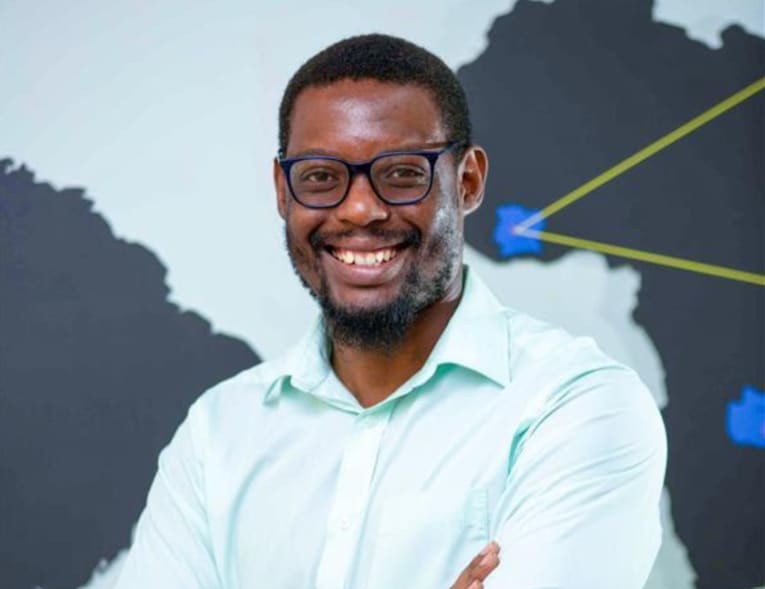
A former firefighter, municipal council public relations officer and current Senior Immigration Officer is using artificial intelligence to build a digital platform aimed at changing how community development projects are managed and tracked in Zambia.
Joseph-James Kapambwe, the founder behind CDF Smart Hub, describes himself as a systems thinker rather than a traditional software developer.
His idea is relatively simple: what if the journey from identifying a community need to delivering and measuring a development project could be connected digitally?
From firefighting to systems thinking
Kapambwe has worn very different uniforms during his career.
He started as a firefighter, later became a Public Relations Officer for a municipal council and now works as a Senior Immigration Officer.
On paper, the careers have little in common.
But Kapambwe says they taught him to look beyond individual problems and understand the systems surrounding them.
That perspective eventually led him to CDF Smart Hub.
Working in rural Zambia, he says he saw how a development need identified by a community could pass through a long chain of meetings, applications, assessments, approvals, procurement, payments, implementation and reporting before residents saw the result.
The controls are necessary when public money is involved.
But the process can also mean a long wait between identifying a problem and seeing development delivered.
The question behind CDF Smart Hub
Kapambwe's starting question was:
What if the process could move even when people did not have to?
Could a Ward Development Committee meet digitally?
Could a project proposal be submitted without travelling to a council office?
Could officials immediately see where a project was stuck?
Could contractors upload progress from the field?
Could citizens see what was happening with projects in their communities?
And could government eventually follow the journey from allocation to measurable results?
These questions became the foundation for CDF Smart Hub.
Building with AI
Kapambwe says he was not a conventional programmer when he began.
Instead, he started experimenting with artificial intelligence, initially using ChatGPT to describe what he wanted to build, generate code, test it and troubleshoot errors.
He later incorporated other AI development tools, including OpenAI Codex and Claude Code, into his workflow.
Rather than viewing AI as a replacement for institutional expertise, Kapambwe describes it as an engineering assistant.
His role, he says, is to understand the system.
Who has authority?
Who is responsible?
What happens at each stage?
Where can the process fail?
And how can technology make it faster without weakening accountability?
That distinction is important to him.
AI can support decision-making, but it should not become the institution itself. Lawful authority and human responsibility must remain with the people and institutions entrusted with them.
The bigger question: what did the money achieve?
As the platform developed, Kapambwe's thinking moved beyond project administration.
He began asking a broader question:
What changed because the money was spent?
If a road was built, did farmers gain better access to markets?
If young people received support, did sustainable businesses emerge?
If agricultural infrastructure was funded, did it help farmers preserve more of their produce?
Did jobs appear?
Did incomes improve?
For Kapambwe, development measurement should therefore extend beyond expenditure and project completion towards economic and social outcomes.
This is also where he sees potential links with Zambia's broader growth ambitions.
CDF Smart Hub is not an official government or Grow Zambia platform, and Kapambwe says it is not intended to replace existing government institutions.
Instead, he sees it as potential digital infrastructure for connecting public investment, implementation and local economic outcomes.
From development projects to agriculture
Living and working in rural Zambia also pushed Kapambwe towards another problem: post-harvest losses.
A farmer can produce a good harvest and still lose value through poor storage, moisture, pests, weak market access or pressure to sell immediately.
CDF Smart Hub has therefore expanded into ideas around digital farmer intake, weighing, quality assessment, aggregation, storage and market access.
The objective is to look beyond production itself and consider how rural communities can retain more value from what they produce.
Why "Flint"?
As the concept expanded, Kapambwe says he wanted the platform's identity to represent something larger than the Constituency Development Fund.
He began using the name Continuum Digital Flint Smart Hub.
"Continuum" represents development as a connected journey.
"Digital" represents the infrastructure connecting people, institutions and processes.
And "Flint" represents the spark.
For Kapambwe, that spark is the central idea.
Sometimes the resources already exist.
The people exist.
The institutions exist.
The opportunity exists.
What is missing is the connection that brings them together.
The next test is implementation
Kapambwe says he has spent about two years developing CDF Smart Hub, largely as a solo AI-assisted founder.
The project was also selected among the Top 100 innovators in the 2026 ZICTA ICT Innovation Programme.
But recognition is not the destination.
Implementation is.
He is now looking for institutional, technical and funding partners to help move the platform from prototype towards real-world deployment.
That may be the most important stage of the project.
Because the challenge for digital development platforms is not simply building software. It is getting technology to work within the institutions, processes and communities it is designed to serve.
For Kapambwe, the reason for building CDF Smart Hub ultimately comes back to the people behind the development statistics.
The woman trying to reach a clinic.
The family waiting for reliable water.
The child who needs a classroom.
The farmer trying to protect a harvest.
The young person looking for an opportunity.
The idea behind CDF Smart Hub is that when the need is already known and the resources already exist, technology should help shorten the distance between the two.
CDF Smart Hub — Where Development Ignites.