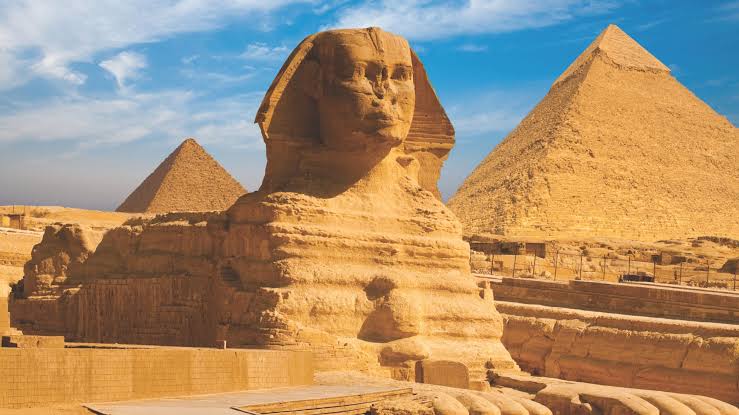
In Kemet, the river kept the accounts.
Every year, when the star Sopdet rose before dawn, the Iteru began to swell. At Abu, on the island below the cataracts, priests descended a stone stairway into the water to read the marks cut into its walls.
The instrument was called the Nilometer.
It did not measure the river's beauty. It measured its promise.
A high flood meant black silt on the fields, full granaries and a prosperous harvest. A low flood meant cracked earth, thin cattle and less grain to collect. The fortunes of the kingdom, and the revenues of its treasury, depended on the water.
That was the oldest rule in Kemet:
You assess the harvest by the river, not by the hopes of the treasury.
The Dream
That year, Pharaoh dreamed.
He stood on the riverbank and watched seven fat cows emerge from the water to graze among the reeds. Behind them came seven lean cows, their ribs showing like the ridges of a dry field.
He awoke troubled and summoned the Priests of the Sky.
They no longer needed a prisoner to interpret dreams. They had instruments, rainfall records and generations of observations.
"The fat cows have already come, Great House," they said. "The granaries are fuller than in living memory. The Overseer of the Granaries planned to purchase one million measures of grain this year. He bought 2,743,393."
"And the lean cows?"
"They are the Child of the Warm Sea. When the distant waters grow warm, the rains of Kemet fail. The Child comes next season."
At the beginning of the year, the court had promised a six-cubit flood. The previous year's mark had been 5.3. But the priests had returned from Abu with a different reading.
NILOMETER: 4.9 CUBITS.
Lower than last year. Lower than promised.
Not a famine. But no longer a feast.
The Scroll of the Two Treasuries
Pharaoh summoned his court to hear the scroll for the coming year.
It was read by Nebamun, Overseer of the Two Treasuries, a careful man who had spent years untangling the debts of an earlier reign.
The scroll bore the title:
Grow Kemet: From Stabilisation to Unlocking Opportunities, Creating Work and Improving Livelihoods for All.
It was the largest scroll ever read in the hall: 284.8 billion deben, an eighth more than the year before.
And much of it was good news.
When the previous reign defaulted, merchants from across the Great Green had come to collect. At the worst point, 45 of every 100 deben the court spent went towards servicing its debts.
Now the figure stood at 23.7 of every 100.
Not long ago, Kemet could finance barely three-fifths of its own expenditure. Now 82 of every 100 deben would come from its own fields, mines and markets.
The tax-gatherers had collected 98, then 104, then 101 parts of every hundred they were asked to deliver. The deficit, which had swollen to 5.9 parts in the year now ending, was to fall to three.
The courtiers applauded. They were right to.
Then Nebamun read the tax assessment.
The applause stopped.
Company tax: from 30.1 billion to 42.7 billion deben. An increase of almost two-fifths.
The tax on wages: up by a tenth.
The tax on every sale in the market: from 16 parts in every hundred to 16 and a half.
An old scribe at the back leaned towards his neighbour.
"The Nilometer says the river is lower," he whispered. "Yet the scroll expects a larger harvest of taxes. One of them is wrong."
"Or perhaps both can be true," replied his neighbour. "The mines are deep, and copper does not care about rain."
The old scribe was not convinced. He remembered another scroll.
The Seer from Beyond the River
Word of the new scroll crossed the Great Green and reached the counting houses of the bondholders.
They had been burned once. They had no intention of being burned again.
So they summoned Bilamun, a seer from beyond the river who read treasuries as priests read entrails. They paid him handsomely and gave him a simple instruction.
"Go to Kemet. Curse the scroll. Tell the world its numbers are sand."
Bilamun mounted his she-donkey and travelled to a high place overlooking Pharaoh's treasury. He opened his mouth to curse.
He blessed instead.
"How shall I curse what the gods have not cursed?" he said. "The old debts have been restructured. The tax-gatherers deliver what they promise. The granaries are full."
He tried again from a second high place.
"The dole for the poorest households rises by more than a third, to 10.36 billion deben, reaching more than 1.6 million households. And Kemet now finances almost all of it from its own treasury. The foreign donors once gave 910 million; now they give 129 million. Pharaoh's contribution rises from 6.7 billion to 10.2 billion."
From a third high place, he continued:
"A new house of skills has been built, and the trades receive 852.7 million deben, three-fifths more than last year. The constituency councils receive 9.05 billion, nearly half as much again. Pharaoh has even insured the land against drought."
The bondholders' messengers tore their robes.
"We paid you to curse!"
"I can only speak what I see," replied Bilamun.
But on the road home, his donkey stopped.
The Donkey Sees
The first time, she stopped at the stairway of the Nilometer and refused to pass.
Bilamun struck her. He could not see what she saw: a sword standing in the water at the 4.9-cubit mark, where a lower flood met a higher tax assessment.
The second time, she stopped beside a storehouse. Its door stood open. Inside, there was nothing.
It had once held the Food Security Pack: seed and fertiliser worth 1.51 billion deben, intended for 320,000 poor farmers.
The new scroll contained no allocation for it.
Perhaps the seed had been moved to another storehouse. Perhaps not. The scroll did not say.
Next door stood the great storehouse of farm inputs. It contained 9.04 billion deben, slightly less than the previous year. Once rising prices were considered, it would buy even less.
The third time, the donkey lay down before a granary whose doors were sealed.
Bilamun beat her again. This time, the donkey spoke.
"Am I not the one who carries the load?" she asked. "I carry the wage tax and the market tax. I carry the grain to the granary. And I know what the scribes do not always say aloud.
"Last year, of every hundred deben the court promised, only 86 reached the road. Of every hundred promised for building, only 72 were spent.
"And 67 billion deben owed to Pharaoh sit uncollected in the books. Almost exactly what he pays his creditors in a year."
ARREARS: 67.0. DEBT SERVICE: 67.6.
"A full granary feeds no one," said the donkey, "if the door stays shut."
Then Bilamun saw the sword.
The Petition of Khunanup
The following morning, a peasant appeared at the palace gate.
His name was Khunanup, of the Salt Field. Every scribe knew the type: upright, stubborn and unfortunately eloquent.
He had paid every due Pharaoh had ever demanded. During the last great drought, he lost his maize, his goats and most of his savings. Still, he paid.
He had not come to curse Pharaoh. He had come to be heard.
Three scribes from the Treasury were sent to receive his petition.
The first was the Scribe of Taxes.
"The scroll is fair," he said. "Anyone earning 20,000 deben or less pays not one grain more than last year. Only the rich are asked for more."
"Not one grain more than last year?" Khunanup replied. "My son earns 10,000 deben in the city. In the reign of the old measures, that wage paid no tax. Today he pays 13 of every 100. The bands do not move, but prices do. He pays more each year simply for standing still."
The second was the Scribe of Granaries.
"Pharaoh has not forgotten the poor," he said. "The dole rises by more than a third."
"I am grateful," Khunanup replied, and he meant it. "But the dole is for households that cannot work. I can work. I am a farmer. I do not want a dole; I want seed.
"The seed pack is gone from the scroll, and the farm inputs are no larger than last year. In a drought year, seed is what separates a lean season from one we can survive."
The third was the Scribe of Accounts.
"Your daughter can study," he said. "Pharaoh has built an entire new house of skills."
"He has," Khunanup replied. "There are 1.95 billion deben for loans to scholars at the great universities, and 1.4 million for bursaries at the trades schools. My daughter wants to become an electrician. Kemet needs electricians. Yet her line in the scroll is less than a thousandth the size of the scholars' allocation."
The scribes exchanged glances.
They had answers, as scribes always do. The constituency councils also offered bursaries. The skills fund was substantial. The new house was only in its first year.
All of it was true.
Khunanup bowed.
"I do not say the scroll is wicked," he said. "I say it was written in a fat year, and it will be read in a lean one."
What Zaphenath-Paneah Knew
That night, Pharaoh sent for the oldest scroll in the royal archive.
It contained the counsel of Zaphenath-Paneah, the foreign-born vizier who had once interpreted another Pharaoh's dream of fat cows and lean ones.
His advice had been simple.
In the years of plenty, take a fifth of the harvest and store it. When the years of want arrive, open the granaries.
Pharaoh read it twice.
His Kemet had performed the first part well. The granaries were full. More than 2.7 million measures of grain had been purchased, and 9.57 billion deben had been set aside to operate the granary agency and pay for what it had already bought.
But Zaphenath-Paneah had raised his levy during the fat years, not the lean. And he had opened the granaries to those who needed them, not only those whose names already appeared on a list.
Pharaoh read further, beyond the passage most courtiers remembered.
The old scroll recorded what happened when the lean years persisted. First, the people spent their silver. Then they sold their cattle, then their land, and finally themselves, until all of Kemet belonged to the throne.
The granary had saved them. It had also come to own them.
It was not simply a story about cruelty. It was a story about timing.
Relief that arrives early is a safety net. Relief that arrives late becomes a debt.
The Rising
In the season of Akhet, the priests descended the stairway at Abu once more.
The river had begun to rise. No one yet knew how far.
The scroll would go before the Assembly, where representatives of the nomes would debate it line by line, as they should.
Bilamun had blessed it. His donkey had warned against it. Khunanup had asked only that it be judged in the season in which it would be lived.
Both could be true.
A budget can restore confidence in the treasury and still leave a farmer without seed. It can improve the debt position while failing to collect billions owed to the state. It can promise more revenue without necessarily creating the economic activity needed to sustain it.
Pharaoh could raise the tax. He could fill the granaries. He could even insure the land.
But the question remained: would the harvest be sufficient to deliver what the scroll promised?
Pharaoh stood at the top of the stairway and watched the water creep towards the 4.9-cubit mark.
In Kemet, the river kept the accounts.
Pharaoh only kept the scroll.
Behind the fable
The story is an allegorical reading of Zambia's 2027 National Budget.
Kemet represents Zambia; Pharaoh represents the Government; Nebamun, Overseer of the Two Treasuries, represents the Minister of Finance and National Planning; Grow Kemet represents the Grow Zambia Agenda; and the Assembly represents the National Assembly.
One deben represents one kwacha.
The Nilometer and the harvest
- 4.9 cubits: The 2027 GDP growth forecast of 4.9%, against 6% previously projected. The 2026 growth projection is 5.3%.
- The Child of the Warm Sea: El Niño and the anticipated drought during the 2026/2027 rainy season.
- The fat cows: The Food Reserve Agency purchased 2,743,393 tonnes of maize by June 2026, against a target of one million tonnes. The National Food Reserves allocation rises from K2.22 billion to K9.57 billion.
The tax assessment
- Company income tax: K30.06 billion to K42.70 billion, with mining contributing K23.3 billion.
- PAYE: K31.78 billion to K35.37 billion.
- VAT: 16% to 16.5%.
Bilamun's blessings
- Debt service falls from 45.5% of expenditure in 2022 to 23.7%.
- Domestic revenue rises from 58.7% of the Budget in 2021 to 82.1%.
- ZRA collected 98%, 104% and 101% of its targets between 2023 and 2025.
- The fiscal deficit is projected to fall from 5.9% to 3% of GDP.
- Social Cash Transfer rises from K7.65 billion to K10.36 billion, targeting 1,639,034 households.
- Skills Development allocation rises from K531.9 million to K852.7 million.
- Constituency Development Fund rises from K6.25 billion to K9.05 billion.
- Government allocates K21.5 million for drought insurance premiums.
The donkey's warnings
- Food Security Pack: K1.51 billion for 320,000 beneficiaries in 2026, with no allocation identified in the 2027 Budget.
- Farmer Input Support Programme: K9.15 billion to K9.04 billion.
- FY2025 expenditure execution: 86% of the final budget was paid; capital expenditure execution was 72%.
- K67 billion in tax arrears recorded by the Auditor-General, against K67.6 billion in annual debt service.
Khunanup's petition
- PAYE bands remain unchanged for salaries of K20,000 or less.
- A K10,000 salary, expressed in 2027 prices, paid no PAYE in 2014 but faces an effective PAYE rate of 13.3% in 2027.
- Social Cash Transfer targets incapacitated households.
- TEVET bursaries: K1.4 million, against K1.95 billion for student loans and scholarships.
The historical references
- Khunanup: The protagonist of the Middle Kingdom Egyptian text Tale of the Eloquent Peasant, adapted here as a petitioner.
- Bilamun: An allusion to Balaam in Numbers 22–24.
- Zaphenath-Paneah: Joseph's Egyptian name in Genesis 41:45. The advice to store grain appears in Genesis 41:34–36; the subsequent famine and its consequences are described in Genesis 47:13–21.
- Nebamun: A historical Egyptian name associated with scribal and administrative traditions.
Sources: KSJ Budget Analysis: The 2027 Budget (8 November 2026); Estimates of Revenue and Expenditure 2027 (Yellow Book), Heads 19, 20, 45, 49, 52 and 89, and revenue estimates; Reuters and Bloomberg reporting on the 2027 growth forecast (October–November 2026).