Book Review | Katondo Street Journal
There are novels that use mythology as decoration, and then there are novels that use mythology as a language through which to interrogate society. Copper Coins and Curses belongs to the latter category.
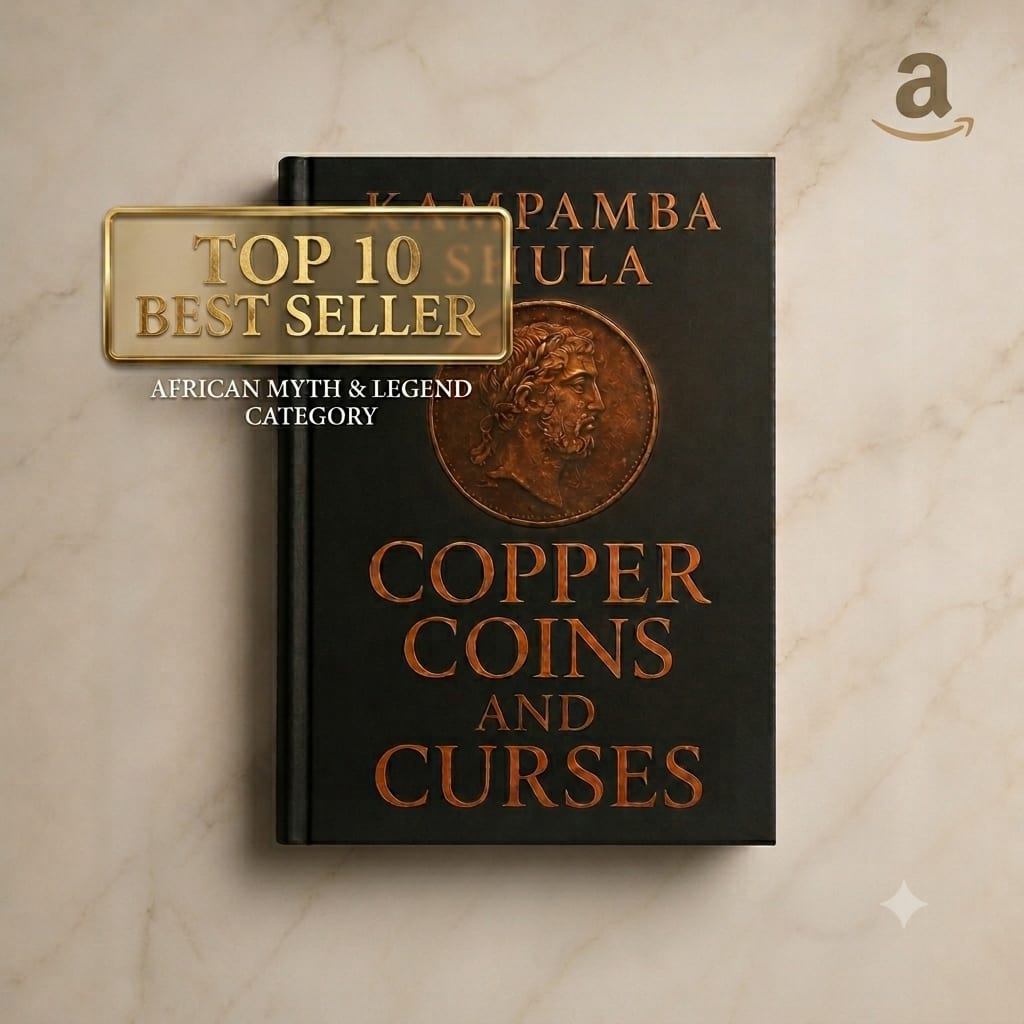
Written by Zambian economist and author Kampamba Shula, the novel is an ambitious fusion of African mythology, fantasy, adventure and economic allegory. At its centre are two young boys, Mosi Nuka and Mwansa Kabinga, whose encounter with the legendary Nyami Nyami and the mysterious Copper Bloodstone opens a much larger story about power, extraction, history and destiny. Their journey extends from the Zambezi to pirate kingdoms, ghost markets, storm-battered islands and haunted Caribbean waters, while ancient relics begin to disturb the boundaries between past, present and future.
But beneath the adventure lies a more serious question: what happens to a society when the thing that gives it wealth also becomes the source of its curse?
That is where Copper Coins and Curses becomes particularly interesting.
The resource curse in mythological form
The concept of the resource curse is usually discussed in the language of economics. Countries endowed with valuable natural resources can paradoxically experience weak institutions, inequality, political instability, corruption, economic volatility and underdevelopment.
Shula takes this familiar economic problem and transforms it into mythology.
Instead of presenting the resource curse through graphs, commodity prices and fiscal statistics, the novel gives it supernatural form. Copper becomes more than a mineral. It becomes an object around which power, greed, history and destiny converge.
The title itself is revealing. Copper represents wealth; curses represent the consequences of how that wealth is acquired, controlled and distributed.
This creates an allegory that is particularly resonant in Zambia, a country whose modern economic history has been deeply intertwined with copper. The author has explicitly described the novel as an exploration of what happens when an economy is built around something it cannot control, arguing that commodity movements ultimately affect ordinary people's jobs, school fees, rent and food prices.
The novel therefore asks an uncomfortable question: Is the resource itself the problem, or is the problem what humans do with it?
Its answer appears to be the latter.
Nyami Nyami as more than a mythical creature
One of the novel's most compelling choices is its use of Nyami Nyami, the legendary Zambezi river spirit, as a force within the story.
In conventional fantasy, a mythical creature can simply function as a source of wonder or danger. Here, mythology performs a deeper function.
Nyami Nyami becomes a bridge between nature, memory and human ambition.
The river is not merely scenery. It represents a world that existed before modern economic systems and will, potentially, survive them. The demand for the return of the Copper Bloodstone therefore carries an almost ecological and moral dimension: something has been taken, and something must be returned.
That makes the mythology feel less like an escape from reality and more like an alternative way of understanding reality.
The supernatural becomes a language for asking questions that economics sometimes struggles to express emotionally.
What does extraction mean to the people who live beside the resource?
What happens when wealth is removed from a place but the costs remain?
Who owns the past?
And can a society extract from nature indefinitely without eventually confronting the consequences?
Copper as metaphor
The copper in the novel operates simultaneously on several levels.
It is a physical resource, a source of wealth, a historical commodity and a symbol of desire.
But perhaps most importantly, it becomes a metaphor for value itself.
Human beings assign value to copper because economies require it. Yet the novel reverses the relationship: copper begins to exert power over human beings.
This is one of the book's richest allegories.
The question is no longer simply, What can copper do for us?
It becomes:
What are we willing to do for copper?
That distinction is fundamental to understanding the resource curse.
Natural resources can finance schools, infrastructure, industry and prosperity. But they can also create incentives for rent-seeking, political competition and short-term extraction. The same resource can become either a foundation for development or a source of distortion.
Copper Coins and Curses dramatises that contradiction through fantasy.
The curse is institutional, not supernatural
Perhaps the most interesting reading of the novel is that its "curse" need not be understood literally.
The curse can be read as an allegory for institutions.
A society does not necessarily become cursed because it possesses a valuable resource. It becomes vulnerable when the institutions surrounding that resource are unable to manage its power.
This is where Shula's background as an economist gives the novel an unusual dimension. The story appears to understand that economic systems are ultimately human systems. Commodity prices may move globally, but the consequences are experienced locally.
A fall in copper prices can become unemployment.
A boom can become currency appreciation and inequality.
A mineral discovery can generate political competition.
A valuable deposit can attract foreign capital while leaving communities questioning what they actually received in return.
The supernatural curse therefore mirrors a very real economic phenomenon: wealth can produce vulnerability when the systems governing it are weaker than the forces exploiting it.
The danger of controlling destiny
The novel's antagonist, Nsembe, adds another important dimension to this argument.
Nsembe is described as a fallen guardian seeking to restore a single "perfect" timeline, even if doing so requires erasing civilizations, futures and lives.
This introduces a second allegory: the danger of believing that complex societies can be engineered towards a perfect outcome by concentrating extraordinary power in the hands of one actor.
There is a striking parallel here with resource economies.
Resource wealth often creates enormous concentrations of economic and political power. Whoever controls the resource can gain disproportionate influence over the country's future.
The novel therefore moves from the question of resource extraction to the broader question of control.
Who gets to decide the future?
Who gets to determine what is sacrificed for progress?
And can the pursuit of a supposedly perfect future justify destroying alternative futures?
These are questions that extend well beyond mythology.
Two boys confronting the machinery of history
Mosi Nuka and Mwansa Kabinga provide an important counterweight to the larger forces surrounding them.
They are young, and their journey places them inside conflicts that existed long before they understood them.
That makes their story symbolic.
They represent a generation inheriting systems, histories and consequences that they did not create.
This is arguably one of the strongest ways to read the novel in a contemporary African context.
Young Africans inherit economies shaped by colonial extraction, commodity dependence, global markets, debt, infrastructure deficits and institutional choices made before their birth. Yet they are also expected to create a different future.
Mosi and Mwansa's journey therefore becomes a journey through inherited history.
The question confronting them is not simply how to defeat the forces pursuing them. It is whether they can break the pattern.
A distinctly African mythology of modernity
There is also something significant about the geographical imagination of the novel.
The story refuses to keep African mythology confined to a narrowly defined African setting. Its journey moves through the Zambezi, the Indian Ocean and the Caribbean, connecting different histories and mythological worlds.
That approach challenges the idea that African mythology belongs only to the past.
Instead, the novel treats mythology as living intellectual material capable of engaging with modern questions about capitalism, extraction, technology, political power and globalisation.
That is an important contribution.
African mythology does not have to be presented solely as folklore. It can also become a framework for speculative thought.
The curse of extraction
Ultimately, Copper Coins and Curses can be read as a story about extraction in its broadest sense.
Humans extract minerals from the earth.
Empires extract wealth from territories.
Markets extract value from commodities.
Power extracts obedience from people.
And sometimes societies extract from the future in order to satisfy the present.
The mythology makes these abstractions visible.
The Copper Bloodstone, the Cursed Copper Coin and the other ancient relics become symbols of concentrated power capable of reshaping destiny. Their danger lies not necessarily in their existence, but in the desire of humans to possess and control them.
This is precisely what makes the novel's resource-curse allegory effective.
The curse is not simply that there is treasure.
The curse is the belief that possessing treasure gives one the right to control everything around it.
A novel worth reading beyond the adventure
As a work of fantasy, Copper Coins and Curses offers mythology, mystery, time travel, supernatural forces and adventure. But reading it purely as an adventure story would miss much of what makes it distinctive.
Its deeper ambition is to ask economic and political questions through myth.
For readers interested in Zambia's copper economy, African development, political economy or the relationship between natural resources and institutions, the novel offers an unusual proposition: perhaps some economic problems are easier to understand when they are turned into stories.
And perhaps mythology has not disappeared from modern African life.
Perhaps it has simply changed form.
The gods have become institutions.
The sacred relics have become commodities.
The curses have become economic structures.
And the ancient struggle over resources continues under the language of markets, contracts and development.
That is the real strength of Copper Coins and Curses. It does not merely place African mythology inside a fantasy adventure. It uses mythology to interrogate one of Africa's most enduring economic questions: why does extraordinary natural wealth so often fail to produce extraordinary human prosperity?
For a Zambian novel, that is an ambitious question.
For an African novel, it is an important one.
And for readers of Katondo Street Journal, it makes Copper Coins and Curses more than a fantasy novel.
It is a story about copper.
But ultimately, it is a story about power, memory, extraction and the price of wealth.