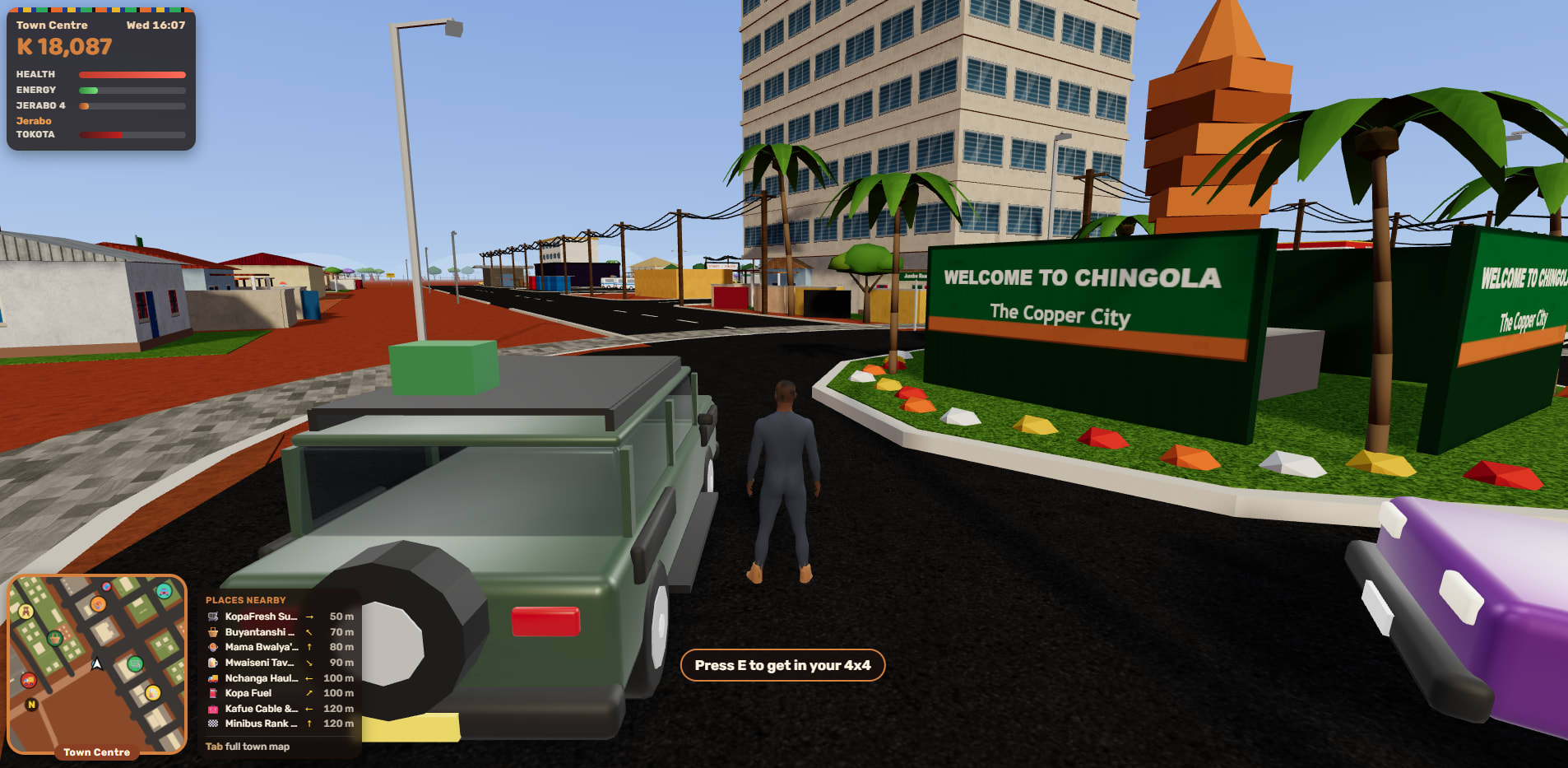
What does Lusaka look like inside a video game?
For Japhet Gondwe, the answer involves more than putting a few Zambian street names on a fictional map.
Gondwe is the founder of Redcode Studios, a Lusaka-based creative technology studio working across software, games, digital art and 3D design.
Its latest and most ambitious experiment is Jila, a driving game being built in Zambia and around Zambia.
Instead of creating another fictional city modelled loosely on familiar Western game environments, Redcode chose a place its developers know firsthand.
Lusaka.
That means recreating roads, buildings, bus stops, markets, vehicles, roadside stalls and other details that give the capital its visual character.
Players can race, compete for leaderboard times, work taxi routes, drive buses or simply cruise around the city.
But Jila is also becoming something beyond a game.
It is an exercise in digital art, 3D modelling and local visual storytelling.
The team has been creating vehicles, characters, buildings, signs and environments while testing how much detail the game can handle.
Some of those experiments have involved deliberately pushing scenes with thousands of vehicles to find the point where the technology begins to struggle.
Jila reached Google Play in September 2026 and remains under active development.
From games to business software
Jila may be Redcode's most visually distinctive project, but it is far from the studio's only experiment.
Before the game, much of its work focused on solving more conventional business problems.
Inkline is a business management and accounting platform covering invoices, expenses, customers, suppliers, stock and financial records.
The premise is relatively straightforward: smaller businesses still need useful management information, but do not necessarily need systems designed around the complexity of multinational corporations.
Then there is ByteMart, which began as a marketplace before expanding into tools for sellers, including digital catalogues, inventory management and structured product information.
The team has experimented with turning information from handwritten stock lists and WhatsApp catalogues into usable digital product data.
It is a practical response to a common problem: businesses may already have the information they need, but it is often trapped in formats that are difficult for software to process.
Making property discovery less fragmented
Redcode has also ventured into property technology with Bondi.
The platform was built around a familiar experience for Zambian property seekers — moving between Facebook posts, WhatsApp groups, agents and word of mouth in search of a house, apartment, piece of land or commercial property.
Bondi brings listings into a searchable platform while allowing landlords, owners and agents to publish properties.
Verification indicators, reporting tools and warnings around unverified listings form part of the platform's approach to safety.
Bondi has surpassed 1,000 downloads on Google Play.
An experimental history
Redcode did not begin with Jila.
Earlier projects included Loc'd In, a community-focused application centred around locs and natural hair, Abekala Chalo, and the colour game I Choose Hue.
Not every experiment became a major product.
But that appears to be part of the studio's philosophy.
Build something. Release it. See how people use it. Learn what does not work. Then carry those lessons into the next project.
The studio's Google Play catalogue effectively documents that evolution.
Where software meets art
The word "Studios" in Redcode's name is deliberate.
The company works across software engineering and creative production, including UI/UX design, branding, illustration, digital artwork, 3D modelling and environment design.
Jila has brought these disciplines together particularly clearly.
A game set in Lusaka creates questions that cannot be solved with code alone.
What should a Zambian market stall look like?
Which vehicles belong on a particular road?
How should a roadside environment be represented?
What makes a digital character feel like they belong in the setting?
Each becomes a design problem as well as a technical one.
That intersection of technology, art and local context is increasingly becoming part of Redcode's identity.
In Conversation with Japhet Gondwe
KSJ: Redcode describes itself as more than a software company. What does being a creative technology studio mean to you?
Japhet Gondwe: For us, software is only one part of the work. We are interested in the combination of code, design, art, storytelling and experimentation. Sometimes that leads to business software, sometimes a marketplace, and sometimes a game. We don't want to limit ourselves to one category.
KSJ: Why was it important to build Jila around Lusaka?
Gondwe: We know Lusaka. It is the environment we live in, so we thought it would be interesting to see what happens when we build a game around a place we actually understand instead of creating another generic fictional city. It also gives us an opportunity to explore what Zambia can look like in a digital world.
KSJ: What has surprised you most about developing Jila?
Gondwe: The amount of work involved in making a place feel authentic. It is not just about putting roads on a map. You start thinking about buildings, signs, vehicles, market stalls, lighting and all the small things people normally don't notice. It becomes a huge art and technical project.
KSJ: Redcode has worked on several very different products. How do you decide what to build next?
Gondwe: A lot of it starts with curiosity. If we think something would be interesting or useful to exist, we ask whether we can build it. We experiment, release things and learn from what happens. Some ideas work better than others, but the process itself teaches us something.
KSJ: What do you think is missing from the way technology is built in Zambia?
Gondwe: I think there is room for more experimentation. We don't always have to start by asking what has already worked somewhere else and then reproduce it here. We can also start with our own environment and ask what technology makes sense from where we are.
KSJ: Where do you see Redcode going from here?
Gondwe: We want to keep building and experimenting across software, games and creative technology. Jila is still developing, and there are always new things we want to try. The main thing is to keep making things and learning from them.
Building from Zambia
That philosophy perhaps explains Redcode better than any individual product.
It is not simply trying to reproduce Silicon Valley products with a Zambian label.
Its approach is more grounded in local problems, local environments and the curiosity to see what can be built.
A property platform because property discovery is fragmented.
Accounting software because small businesses need better tools.
A marketplace because sellers need more than a place to list products.
And a driving game because someone wondered what Lusaka would look like as a digital world.
For a small studio in Lusaka, the ambition is notable not because every experiment will necessarily succeed, but because the studio is willing to build, release, test and try again.
Sometimes innovation is a new piece of technology.
Sometimes it is simply taking something familiar and asking:
What if we built it ourselves?
For Japhet Gondwe and Redcode Studios, that question has already produced a growing collection of software, games and digital worlds — increasingly shaped by the place from which they are being built.
Redcode Studios — Lusaka, Zambia