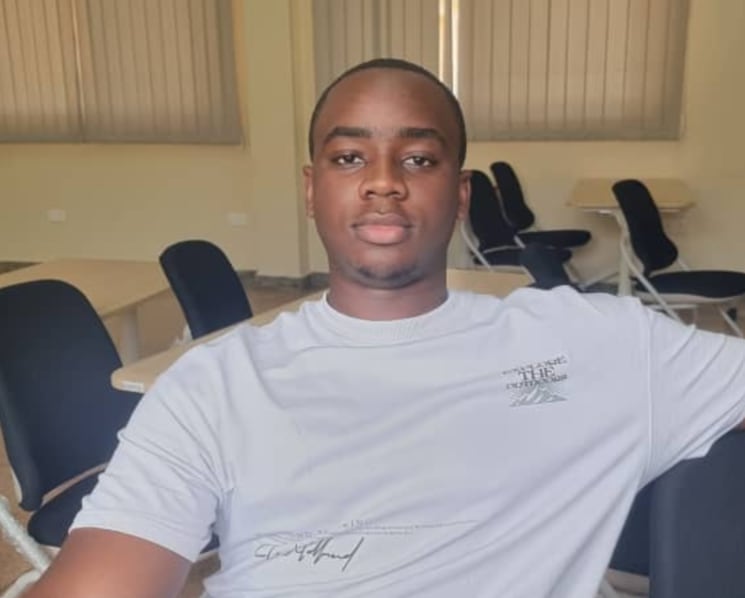
Emmanuel Charlie Mukange is not building Corexis as a single-product startup. He is trying to build an AI lab.
The founder and CEO is developing focused artificial intelligence products across health, agriculture, transport and mining, with each product operating as its own line under the Corexis umbrella.
The company is already among ZICTA's Top 100 ICT innovators for 2026, giving an early signal of interest in its approach.
Its first major bet is healthcare.
Aide AI, Corexis' flagship product, is a free mobile application designed to help people make sense of their symptoms and decide what to do next. It is expected to launch in October 2026.
Starting with the moment before the clinic
Mukange's starting point is relatively simple.
When people feel unwell, they do not always need — or have immediate access to — a diagnosis. Often, they want to know whether something is serious, what they can do in the meantime and where they should seek care.
That is the gap Aide is designed around.
Users can describe their symptoms in English, Ichibemba, Chitonga, Chichewa or Swahili. Aide asks follow-up questions, flags situations requiring urgent attention, provides comfort measures for minor issues and points users towards nearby health facilities.
It can also generate a summary that the user can take to a health worker.
Mukange puts the proposition plainly:
“Most people who feel unwell aren't looking for a diagnosis. They want to know whether it's serious, what to do tonight, and where to go tomorrow.”
AI, but with limits
Aide's positioning is deliberately narrower than an AI doctor.
It does not diagnose, prescribe or advise users on medication.
Instead, it is designed to support decisions about urgency and care navigation. Emergencies and pregnancy-related concerns are escalated.
For Mukange, the technology is intended to help someone get to appropriate human care — not replace it.
Why languages matter
One of the more distinctive parts of the product is its language strategy.
Aide is being built Zambia-first, allowing users to communicate in languages they actually use at home.
For Mukange, this is more than translating an English application.
If AI is going to be useful beyond a relatively narrow technology-literate audience, the interface has to meet people where they are.
That makes language part of the product itself.
A young founder with a bigger ambition
Mukange is studying for a B.S. in Data Science and AI at IIT Madras Zanzibar while building Corexis from Lusaka.
His ambition extends well beyond healthcare.
Corexis is developing separate AI products for several sectors, reflecting Mukange's view that AI opportunities in Africa will not necessarily come from one giant platform, but from focused tools built around specific problems.
The company's stated vision is to become Africa's leading multi-sector AI lab.
That is an ambitious proposition for a young company. The immediate challenge is proving that its first products can move from promising technology to products that people actually use.
Early validation
Beyond its ZICTA recognition, Corexis has been selected for the IIT Madras Zanzibar Centre for Innovation and Entrepreneurship cohort.
Aide also reached the Top 25 at the PAAIS Hack-AI-Thon in Accra in September 2026.
But the bigger milestone is now approaching.
When Aide launches in October, Mukange will move from building and pitching the product to learning from real users.
Will people trust it with their symptoms? Will local-language interaction work naturally? And will it actually help people navigate care more effectively?
Those questions will matter more than the AI label itself.
Building from Zambia outward
There is a broader story behind Corexis.
Mukange is attempting to build technology around African problems from the beginning — rather than taking a product designed elsewhere and simply adapting it to the local market.
Aide is the first test of that philosophy.
If it works, the same approach could extend into the other sectors Corexis is targeting.
For now, however, the founder has a much more immediate task: getting Aide into people's hands and finding out whether the idea works outside the pitch deck.
For Mukange, the AI lab starts with one product. The real ambition is much bigger.
Connect with Corexis
Website: corexis.org
Founder & CEO: Emmanuel Charlie Mukange
Email: mukangece@gmail.com
Phone/WhatsApp: +260 761 252 979
Headquarters: Lusaka, Zambia
Aide AI: Follow Aide AI on Facebook