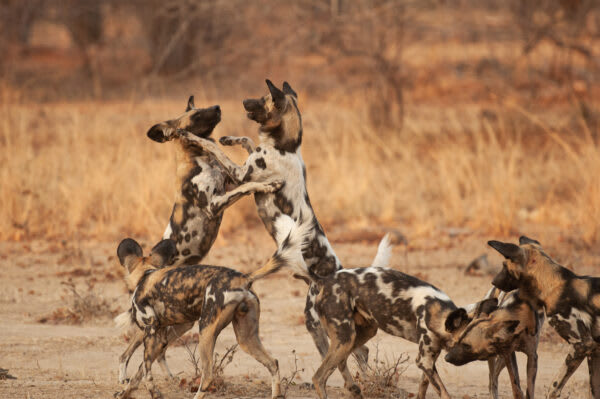
Three African wild dogs have travelled 4,126 kilometres across Zambia, setting a new record for mammal movement on the continent—and providing an unusual map of how wildlife still moves through a rapidly changing landscape.
The three litter mates, known as the Mayukuyuku males, left their birth pack in Kafue National Park in mid-2025 in search of territory and mates.
Over the next nine months, they moved east and north through landscapes around Kitwe and Ndola before continuing towards the Luangwa Valley.
By April 2026, they had settled in a Game Management Area between South Luangwa and Lower Zambezi National Parks.
The journey is also the longest recorded wild dog dispersal globally, according to research published by the Zambian Carnivore Programme (ZCP).
What makes the journey significant is not simply its distance. The dogs crossed protected areas, settlements and heavily developed landscapes, showing that wildlife movement in Zambia extends well beyond national park boundaries.
The danger between protected areas
Tracking data shows that wild dogs tend to move quickly and in relatively straight lines when travelling through unfamiliar territory. Researchers say this resembles their response when escaping lions, suggesting that a survival behaviour developed around natural predators may also help them navigate human-dominated landscapes.
But speed offers little protection against vehicles, livestock conflict, disease and wire snares.
The dogs also face natural threats, including lions, crocodiles and rival packs.
The previous long-distance record, set in 2021, ended tragically. Three female wild dogs from South Luangwa travelled more than 2,300 kilometres over 11 months, crossing farmland, settlements and an international border before all three were killed by a poaching snare.
The latest research underlines how difficult dispersal can be. The ZCP says up to half of dispersing wild dogs may not survive naturally, with human pressures increasing the risks. Half of the long-distance movements tracked in the study ended with a wild dog dying in a wire snare.
The conservation question
The Mayukuyuku journey makes a straightforward point for conservation planning: protecting wildlife inside national parks is only part of the equation.
Wild dogs need the wider landscape to disperse, establish new territories and find mates. That means the areas between major wildlife strongholds also need attention, particularly where animals encounter farms, settlements and roads.
Reducing wire snaring, managing human-wildlife conflict and maintaining viable routes between wildlife areas are therefore central to giving dispersing animals a chance of survival.
The three males have shown that a route between Kafue and the Luangwa Valley is still possible.
The challenge now is keeping it possible.