Every evening between October and December, the forest at Kasanka National Park begins to move.
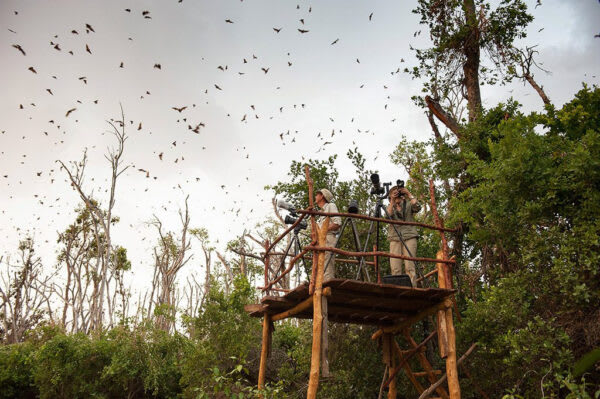
As the sun drops, straw-coloured fruit bats emerge from the evergreen Mushitu forest in numbers that can reach millions, turning the sky above the trees into one of Zambia's most unusual wildlife spectacles.
Everwild has confirmed that its semi-permanent bushcamp will operate during the 2026 bat migration season, from 25 October to 1 December, with approval from the Kasanka Trust and the Department of National Parks and Wildlife (DNPW).
Preparations include repairs to the bat hides and maintenance of access infrastructure. The announcement follows changes to accommodation operations in the park, including the closure of Wasa Lodge for the 2026 season.
A migration unlike any other
Kasanka's annual gathering of straw-coloured fruit bats (Eidolon helvum) is among Africa's most unusual wildlife events.
Up to an estimated 10 million bats can gather in a relatively small area of evergreen forest. The Kasanka Trust describes the seasonal colony as possibly the largest concentration of mammals known in the world.
The scale becomes most apparent at sunset.
As darkness approaches, bats begin leaving the forest to forage. What starts as a few animals quickly becomes a vast movement across the sky, with thousands and eventually millions heading into the surrounding woodland.
Unlike the better-known migrations of wildebeest and other large mammals, Kasanka's migration happens above the forest rather than across open plains.
There is also an important scientific question behind the spectacle: why do such enormous numbers converge on this particular site?
Seasonal fruit availability is thought to be one factor. The bats also travel considerable distances beyond the park each night to feed, linking the roost to a much wider landscape.
The landscape beyond the roost
That wider range matters for conservation.
The bats may spend the day concentrated in a relatively small section of forest, but their nightly movements take them beyond the park. Protecting the roost is therefore only one part of protecting the migration.
Straw-coloured fruit bats also play important ecological roles as seed dispersers and pollinators. Their movements help connect different parts of the landscape and contribute to forest regeneration.
Kasanka's bat season is therefore more than a wildlife spectacle. It is an example of how an apparently local natural event can depend on ecological conditions across a much larger area.
More than the bats
Kasanka's wildlife extends beyond the migration.
The park contains miombo woodland, evergreen forest, wetlands, dambos and river systems, supporting a wide range of species. It is particularly notable for its population of sitatunga, a semi-aquatic antelope associated with its wetlands.
The concentration of bats also attracts predators, including birds of prey, creating another layer of wildlife activity around the evening emergence.
But it is the bats that give this period its distinctive character.
For several weeks each year, millions of animals leave the forest at dusk in a movement that remains only partly understood.
That combination of scale, ecological importance and scientific uncertainty is what makes Kasanka's migration worth watching.
The 2026 season begins on 25 October.