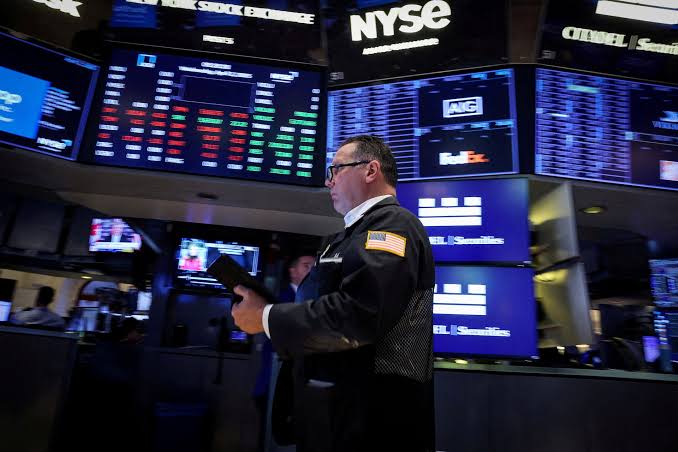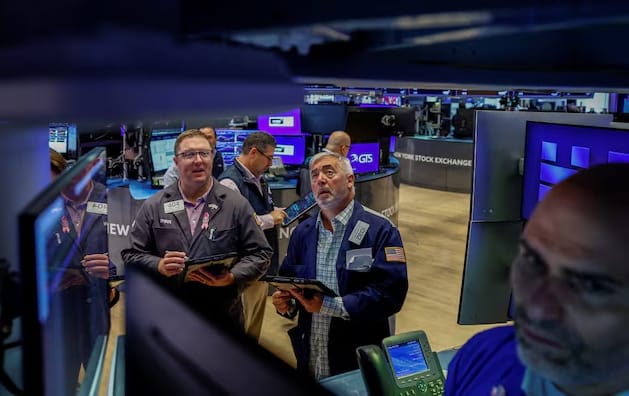
Wall Street took a step back on Wednesday as rising Treasury yields, renewed tensions around Iran and weakness in some of the biggest technology names combined to put pressure on US stocks.
The S&P 500 fell 0.65% to 7,714.35 points, while the Nasdaq dropped 1.07% to 26,953.87. The Dow Jones Industrial Average was down 0.54% at 51,583.98.
Much of the day's attention, however, was outside the stock market.
Oil prices climbed more than 3% after Iranian President Masoud Pezeshkian told the United Nations that Tehran would not surrender to US pressure. His comments came a day after US President Donald Trump warned that the US could "annihilate" Iran.
The immediate market concern is straightforward: a deeper Middle East confrontation could disrupt energy markets and push inflation higher.
That was reflected in energy stocks. The S&P 500 energy sector gained about 1%, while higher oil prices added another layer of uncertainty for investors already watching interest rates closely.
Rates are back in the conversation
The bigger story for Wall Street, though, may be the bond market.
A survey of US business activity showed the economy accelerating to its strongest pace in more than five years in September. The stronger economic data pushed Treasury yields higher as investors reassessed the path of US interest rates.
Two-year Treasury yields reached their highest level since 2024, while the 10-year yield touched its highest level since 2007.
For equity investors, that matters because higher yields increase the return available from relatively safer government debt while also raising borrowing costs for companies and consumers.
The market is therefore facing a familiar tension: a stronger economy is good news in isolation, but if that strength keeps inflation elevated, the Federal Reserve may have less room to cut rates.
Traders were pricing in a 71% probability of another Fed rate increase at the October meeting, according to CME Group's FedWatch Tool.
Federal Reserve Governor Michael Barr also said further rate increases may be necessary, with inflation still above the central bank's 2% target.
Big Tech shows cracks
Technology stocks, which had helped push Wall Street towards record highs in recent sessions, were among Wednesday's notable decliners.
Alphabet fell 3.5%, while Amazon dropped 2.4%. Nvidia declined 1.6%, contributing to a 1.4% fall in the PHLX semiconductor index.
Meta, however, moved in the opposite direction, gaining 2.3%. The company's shares have now risen about 13% this week following a strong reception for its "Muse" AI assistant.
The contrasting performance highlights an increasingly important feature of the AI trade: investors are no longer treating every technology company as an automatic winner from the AI boom.
AI is creating opportunities for companies providing computing infrastructure and software, while potentially disrupting established businesses in areas ranging from advertising and banking to online commerce.
Amazon's decision to block Muse from its shopping platform adds another dimension to that competition.
Travel companies also had a difficult session, with Expedia and Airbnb both falling more than 6%.
The market is still close to its highs
Despite Wednesday's pullback, the broader market remains relatively elevated.
The Nasdaq had recorded record-high closes in each of the previous two sessions, while the S&P 500 remains less than 2% below its record closing level from August 13.
The S&P 500 is trading at just under 19 times expected earnings, according to LSEG data. Much of the improvement in earnings expectations has been driven by major companies linked to the AI investment cycle.
That leaves investors balancing two very different stories.
On one side is a US economy showing considerable strength and an AI sector still attracting enormous investor interest.
On the other is a combination of geopolitical risk, higher oil prices and rising bond yields that could keep interest rates higher for longer.
For markets, the question is increasingly whether economic strength can continue without producing another round of inflation pressure.
For now, Wednesday's trading suggested investors are becoming less willing to ignore that risk.